

Rocket Lab Corporation (NASDAQ: RKLB) is an end-to-end space company delivering reliable launch services, complete spacecraft design and manufacturing, satellite components, and on-orbit management.
What does RKLB do?
RKLB is an aerospace manufacturer and launch service provider that offers end-to-end mission services. Currently, it provides frequent access to orbit for small satellites through its Electron rocket and is a major manufacturer of spacecraft components and entire satellite constellations.
The company’s operations are divided into two primary segments:
- Space Systems (58% of 2025 Revenue): The company’s highest-margin and primary revenue driver. It designs and manufactures satellite components (star trackers, reaction wheels, solar cells) and entire spacecraft like the Photon satellite bus. In December 2025, it secured its largest-ever contract, an $816 million award from the Space Development Agency (SDA) to build 18 satellites.
- Launch Services (42% of 2025 Revenue): Operates the Electron rocket, the world’s most frequently launched orbital small rocket, and the HASTE rocket for suborbital hypersonic testing. Rocket Lab is currently developing Neutron, a medium-lift reusable rocket designed to compete with SpaceX’s Falcon 9.
What Value does RKLB offer?
As an end-to-end “Space Prime“—a vertically integrated provider that can design, manufacture, launch, and operate complex orbital infrastructure under one roof. Unlike competitors that focus solely on launch, Rocket Lab captures more value per mission by supplying both the rocket and the satellite hardware, offering a “one-stop shop” for commercial and government customers. Its core pillars are:
- Vertical Integration: By manufacturing critical components in-house (such as solar cells, star trackers, and reaction wheels), Rocket Lab reduces third-party dependency, protects margins, and accelerates mission timelines.
- Dedicated Small-Launch Leadership: Its Electron rocket provides frequent, reliable, and “bespoke” access to orbit for small satellites, serving as a premium alternative to SpaceX‘s mass-rideshare model where customers have less control over specific orbital insertion.
- Strategic Defense & Civil Partner: The company is a trusted prime contractor for the U.S. government, evidenced by major awards like the $816 million Space Development Agency (SDA) contract to build 18 satellites.
- Expansion into Medium-Lift: The development of Neutron aims to challenge the Falcon 9’s dominance in the high-growth constellation market, offering a reusable, cost-efficient solution for larger payloads starting in late 2026.
What is the Markets’ Take and Why?
Investors view RKLB with a mixture of high-conviction long-term optimism and immediate short-term skepticism. While the company’s fundamentals are stronger than ever, recent execution delays have caused significant volatility in the share price.
Bullish
- Record Backlog and Revenue Growth: Rocket Lab ended 2025 with a record $1.85 billion backlog, a 73% increase year-over-year, and expectations of about 37% conversion to revenue within the next 12 months. Annual revenue (2025) reached a record $602 million, growing 38% over 2024, and guidance for Q1 2026 suggests continued strong growth of 57% Y/Y.
- SDA Validation: In late 2025, the company secured its largest ever contract from the Space Development Agency (SDA) to build 18 satellites, solidifying its status as a major defense prime.
- High-Margin Space Systems Expansion: Space Systems accounted for 58% of 2025 revenue which typically carries higher non-GAAP gross margins (reaching 44.3% in Q4 2025) compared to launch services. By manufacturing its own reaction wheels, star trackers, and solar cells, Rocket Lab captures more value per mission and mitigates supply chain risks that plague competitors.
- The “Neutron” Opportunity: Neutron is designed to carry 13,000 kg, allowing Rocket Lab to compete directly with SpaceX’s Falcon 9 for large-scale satellite constellation deployments.
- Reusable technology: allows Rocket Lab to significantly lower launch costs and boost long-term profitability.
- The Premier SpaceX Alternative: Rocket Lab is viewed as the only “bespoke” alternative for customers who do not want to rely solely on SpaceX’s rideshare model.
Bearish
- Further “Neutron” delays: On February 26, 2026, management pushed the maiden launch to the fourth quarter of 2026 following a Stage 1 tank rupture during testing in January. The failure was traced to a manufacturing defect in a critical joint, forcing the company to pivot entirely to Automated Fiber Placement (AFP) machines. Because Neutron is the “cornerstone” for reaching long-term profitability, these repeated setbacks raise concerns about the company’s ability to compete with SpaceX’s established Falcon 9 in the lucrative medium-lift market.
- High Cash Burn and Lack of Profitability: Despite record revenues, Rocket Lab remains a “money-losing” entity with significant capital requirements. Elevated burn-rate, net losses with the path to being cash-flow positive tied to a successful Neutron debut, and margin compression have investors wary of commitment.
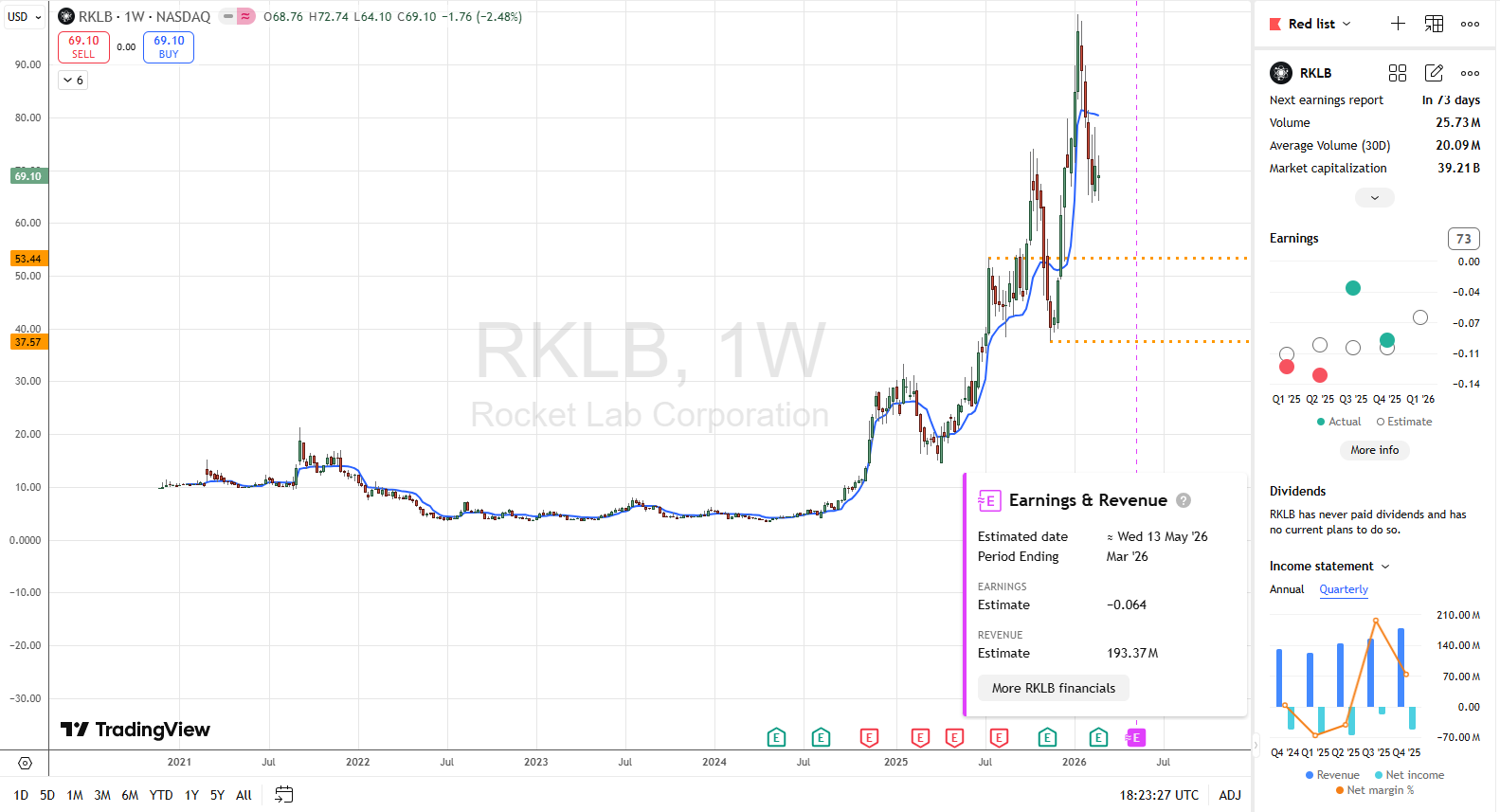
- Aggressive Valuation: A growing feeling among investors that the stock’s recent surge has left it overvalued. As of late February, RKLB trades at an estimated 61x EV/FY2025 Sales – a massive premium to the aerospace and defense peer group.
- Heavy Insider Selling: significant insider selling in early 2026 – CFO Adam Spice sold approximately $103 million in shares in January, just weeks before the Neutron delay announcement, which has weighed on retail sentiment.
- Competitive Pressures: The “SpaceX Moat” remains a structural threat to Rocket Lab’s long-term pricing power in the launch market.
Upcoming Catalyst(s)
- Neutron Maiden Launch (Q4 2026): Following a propellant tank failure in January 2026, the inaugural flight has been delayed to at least the fourth quarter of 2026.
- Revenue Conversion: expects approximately 37% of its record $1.85 billion backlog to convert to revenue over the next 12 months.
- Mynaric Acquisition: The pending acquisition of German laser communications firm Mynaric faces regulatory delays from the German government and the possibility of a competing bid from Rheinmetall that could significantly impact Rocket Lab’s satellite manufacturing vertical.
- Upcoming Earnings Reports: Q1 2026 Earnings (Expected May 13, 2026)
- SpaceX Market Activity: Any further news regarding a potential SpaceX IPO in late 2026 is expected to serve as a sectoral catalyst, potentially re-rating public space peers like Rocket Lab.
(** NOT FINANCIAL ADVICE **)
The only competitor to SpaceX should be enticing enough to sell cash-secured PUTs with strikes between $35 to $55 and 30 – 60 DTE.