
The space economy is currently staging one of its most complex structural proxy wars, centered on a tech sector that sounds like science fiction: direct-to-cell satellite broadband.
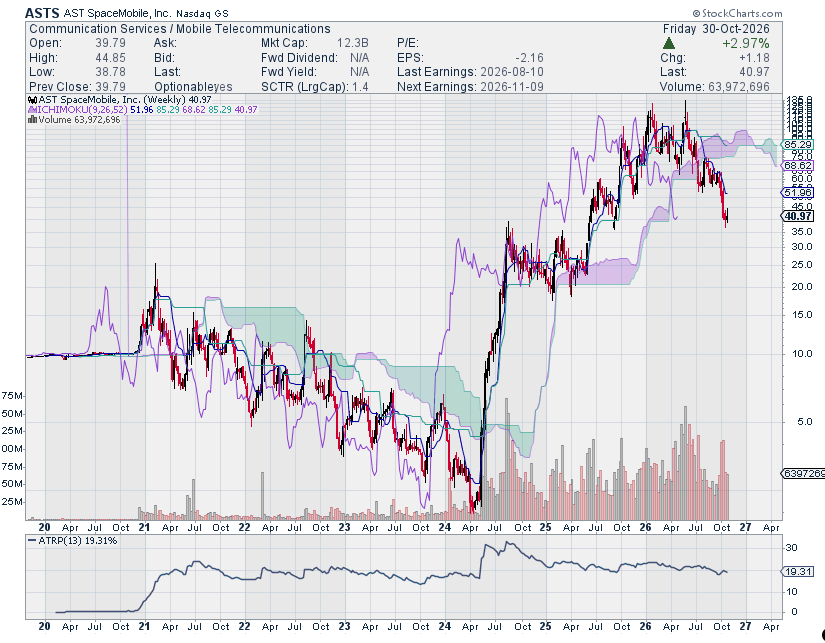
At the center of this battle sits AST SpaceMobile (ASTS). Once a retail investor darling, the stock has transformed into a high-stakes institutional battleground, characterized by extreme volatility and an aggressive surge in short-selling demand.
To evaluate whether ASTS represents the future of telecommunications or a highly capital-intensive trap, we must dissect the market mechanics, the geopolitical carrier alliances, and the brutal physics of low Earth orbit (LEO).
Market Mechanics: The “Price of Doubt”
The stock borrow rate—the annualized interest fee brokers charge to loan out shares for short selling—serves as the primary institutional gauge of market skepticism.
When short demand spikes or share supply dries up, this rate can climb into double or triple digits. High borrow rates compress a short seller’s timeline; a 100% borrow rate forces a position to bleed roughly 0.27% of its aggregate value daily just to remain open. If a positive operational catalyst occurs, this compounding friction forces short sellers to panic-buy shares to cover their deltaA measure of the change in an option's price for every $1 change in the underlying instrument. It also serves as a rough proxy for the probability that the option will expire in the money. More exposure, establishing the foundation for a short squeeze.
ASTS: The Coiled Spring Anomaly
Evaluating AST SpaceMobile (ASTS) through active equity lending and market microstructure data exposes a classic structural paradox:
- Aggregate Short Interest: 64.83 million shares
- Short Percent of Float: 21.06% of free float (Signaling institutional overcrowding)
- Short Interest Ratio: 6.1 Days to Cover (DTC)
In quantitative risk models, a short float exceeding 20% paired with 6.1 Days to Cover indicates an exceptionally narrow exit door. Based on average daily trading volumes, it would require more than six full trading sessions of uninterrupted buy-side liquidation for short positions to completely cover their exposure.
The Carrying Cost Illusion: Depressed Lending Friction
Despite an overcrowded short float, the immediate daily capital drain on bears has temporarily neutralized due to a dislocation in securities lending pools:
- Available Borrow Inventory: 1.4 million loanable shares
- Active Cost-to-Borrow (CTB) Rate: 0.80% annualized baseline
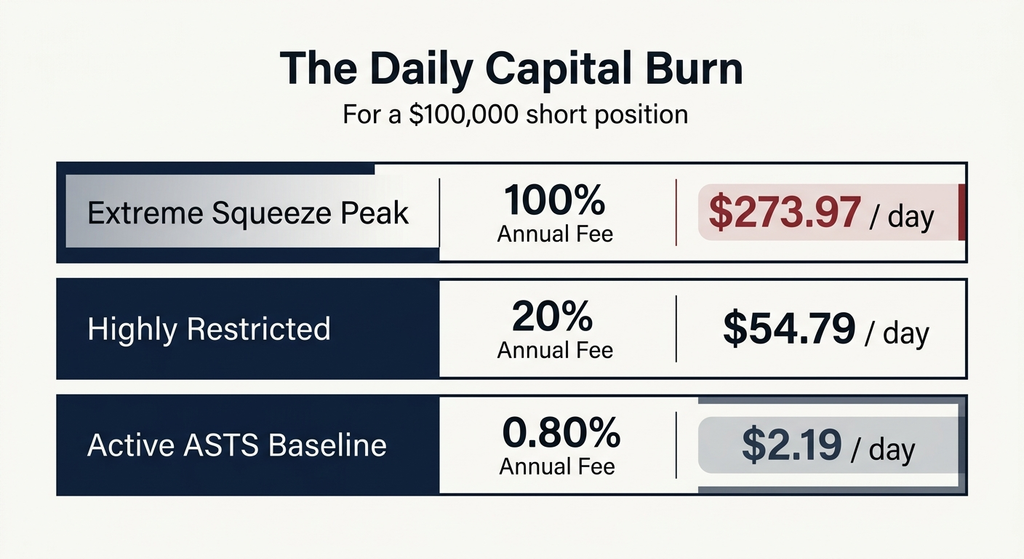
Because brokers currently hold sufficient loanable supply, short sellers are not being programmatically forced out by high daily financing fees. They possess the luxury of time to wait out operational delays.
However, because the underlying short position size remains massive, the market structure functions like a coiled spring. The moment ASTS prints a verified acceleration in its timeline, the scramble for top-of-book liquidity will trigger an immediate multi-day exit bottleneck.
Financial Liquidity vs. The Launchpad Bottleneck
A granular fundamental analysis reveals a stark divergence between ASTS’s balance sheetA financial "snapshot" that reveals exactly what a company owns and owes at a specific moment in time. It follows the fundamental formula: Assets = Liabilities + Equity. By subtracting what is owed (liabilities) from what is owned (assets), the balance sheet shows the "book value" or the net worth belonging to the owners. More durability and its physical operational execution:
- The Capital Runway: Insolvency risk is fundamentally de-risked. Backed by a $1.0 billion convertible debt offering, the company commands $2.29 billion in cash. Against an annual operational cash burn of -$401 million, ASTS maintains a secure 3-to-4-year financial runway.
- The Production Slump: The core execution risk remains pinned to the launchpad manifest. Wall Street analysts recently slashed near-term orbital projections, estimating ASTS will field just 18 operational satellites by the end of this year, down from an initial target of 45.
- The Commercial Impact: Because continuous, profitable broadband coverage requires a localized fleet of 45 to 60 units, the commercial rollout of space-based cellular services has been deferred into the second half of 2027.
Architectural Philosophies: Gargantuan vs. Swarm
The fundamental competitive threat stems from Elon Musk’s SpaceX, but the two entities are approaching the direct-to-cell problem with entirely opposing engineering philosophies.
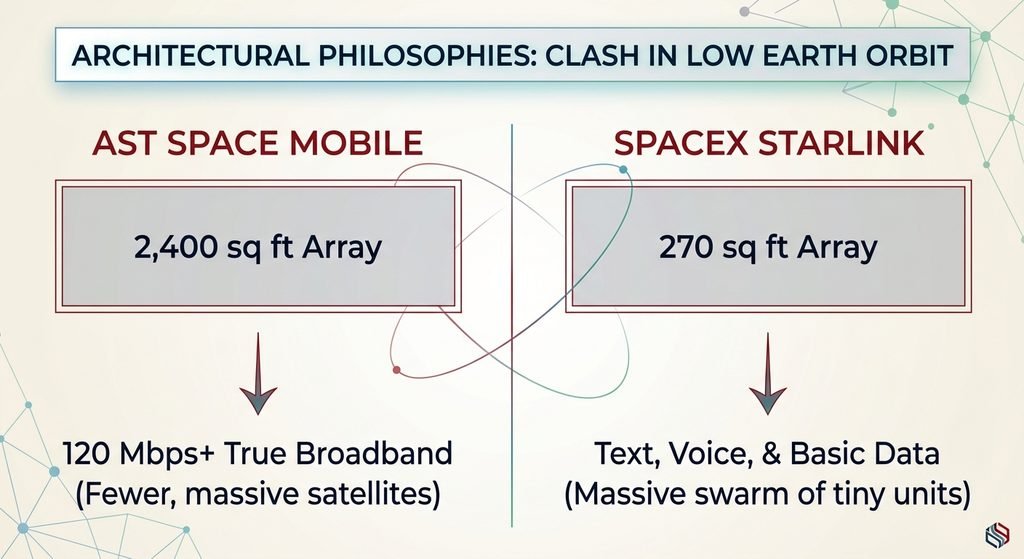
ASTS deploys massive, origami-folding BlueBird Block 2 satellites boasting 2,400-square-foot phased arrays. Operating at 100 to 120 kW of power, these units utilize advanced computerized beam-forming to project “virtual cellular towers” onto fixed patches of Earth. The raw physical size of the antenna allows it to capture incredibly weak smartphone signals from orbit, delivering true broadband speeds of 120 to 200 Mbps directly to unmodified consumer phones.
SpaceX’s Starlink Mobile relies on a swarm approach, utilizing significantly smaller 270-square-foot antennas. Because smaller arrays capture weaker signals, SpaceX’s current Direct-to-Cell fleet is structurally throttled, limited primarily to text messages and basic data. While SpaceX is designing massive “V3” satellites to bridge this performance gap, those units are too heavy for standard Falcon 9 rockets and hinge entirely on the commercial readiness of Starship.
Under the Hood – How It Works
- Simulating a Tower: Traditional cell towers sit on the ground and project a “cell”—a specific radius of radio frequency coverage. The software on an ASTS satellite mimics this exact terrestrial architecture. It takes a massive beam of radio frequency energy and projects a localized cone of coverage directly onto a 20-to-30-mile patch of land.
- Tricking the Phone: Because the satellite’s phased array antenna is so massive and powerful, the signal hitting the ground is identical in frequency, strength, and protocol to a standard ground tower. When your smartphone connects to it, the phone’s internal software is effectively “tricked” into thinking it is talking to a standard AT&T or Verizon tower down the street, completely unaware that the source is moving at 17,000 mph in space.
- The “Fixed” Part: Even though the satellite itself is flying across the sky at blistering speeds, its advanced phased array uses computerized beam-forming to keep the footprint anchored to a fixed spot on Earth. As the satellite moves over, it electronically “steers” the signal cone backward to stay locked onto the same geographic dead zone until the next satellite passes over and hands off the connection.
The MNO Proxy War & The SpaceX Dilemma
The ultimate structural nuance of ASTS is a deeply ironic dependency: ASTS relies on SpaceX’s Falcon 9 rockets to launch its own satellites.
While antitrust frameworks prevent SpaceX from outright denying launch services to a paying customer, SpaceX controls the launch manifest. SpaceX will naturally prioritize its own mega-constellation, leaving ASTS exposed to launchpad delays. Furthermore, potential buyouts of ASTS by SpaceX remain highly unlikely due to intense antitrust and monopoly scrutiny from the FCC and FTC.
However, SpaceX’s aggressive push to gain FCC spectrum approval and operate as a direct, competing mobile carrier has triggered a corporate counter-response. By positioning itself as a threat to traditional Mobile Network Operators (MNOs), SpaceX has turned ASTS into a defensive weapon.
Massive, well-capitalized legacy carriers like AT&T and Verizon have heavily backed ASTS. They view the company as an essential infrastructure shield to protect their terrestrial subscriber bases from being poached by Starlink Mobile.
The Bottom Line
AST SpaceMobile has successfully proven its core technology and de-risked its balance sheetA financial "snapshot" that reveals exactly what a company owns and owes at a specific moment in time. It follows the fundamental formula: Assets = Liabilities + Equity. By subtracting what is owed (liabilities) from what is owned (assets), the balance sheet shows the "book value" or the net worth belonging to the owners. More. It is no longer a question of if the engineering works, but when the hardware can get to space. For ASTS, the road to absolute market dominance is a race against a clock controlled by its fiercest competitor.
Currently, the combination of deferred commercial scale tied directly to delays in the launchpad manifest, coupled with broader macroeconomic equity volatility triggered by interest rate transitions, has emboldened the bears. The key determinant remains infrastructure delivery. If ASTS executes its launch pipeline over the next 18 months, this stock retains the structural mechanics to be a generational multi-bagger.