
AST SpaceMobile, Inc. (NASDAQ: ASTS) is building the world’s first and only space-based cellular broadband network designed to connect directly to standard, unmodified smartphones (and other cellular devices), delivering 4G/5G voice, video, data, and broadband services for both commercial and government use.
What does ASTS do?
AST SpaceMobile designs, manufactures, and deploys large BlueBird satellites in low Earth orbit (LEO). These satellites feature the largest commercial phased-array antennas ever placed in LEO (up to ~2,400 square feet on Block 2 satellites). The network uses mobile network operators’ (MNOs’) licensed low- and mid-band spectrum (plus AST-controlled MSS spectrum) and integrates with carriers’ core networks.
Users connect with everyday phones—no special hardware, apps, or modifications required. The service targets coverage gaps, remote areas, and seamless supplemental coverage. AST partners with more than 60 MNOs worldwide (including AT&T, Verizon, Vodafone, Rakuten, Bell Canada, Telus, stc Group, and others) representing over 3 billion subscribers combined. It also pursues dual-use government applications (secure communications, radar, emergency response, IoT, AI edge compute).
As of mid-August 2026, 13 BlueBird satellites are in orbit (combined aperture ~20,000 sq ft). Manufacturing capacity supports multiple satellites per month, with BlueBirds 14–46 in various stages of production. The company aims for non-continuous service in targeted markets with ~25 satellites and continuous coverage in key markets (U.S., Europe, Japan, etc.) with ~45–60 satellites.
What Value does ASTS offer?
- Closes massive connectivity gaps: ~87% of Earth’s surface lacks traditional mobile coverage; billions of people remain unconnected or experience frequent dead zones. AST targets the ~5.8 billion mobile users who move in and out of coverage and the 2+ billion still unconnected to cellular broadband.
- True broadband, not just messaging: Unlike some competitors focused on emergency texting, AST delivers full 4G/5G capabilities (voice, video calls, streaming, apps) at commercially useful speeds (demonstrated up to ~21–99 Mbps on earlier satellites; next-gen targeting near 200 Mbps peaks).
- Carrier-centric B2B2C model: Works with existing MNOs rather than competing against them. Carriers can offer seamless “supplemental coverage from space” to their own subscribers using existing spectrum and billing relationships. This lowers customer-acquisition friction and accelerates adoption.
- Capital-efficient constellation architecture: Larger, more powerful satellites enable broader coverage and higher capacity with far fewer satellites (~90 for global continuous service) than mega-constellations requiring tens of thousands.
- Expanding dual-use / government opportunity: Growing pipeline of U.S. government and allied contracts for secure communications and non-comms applications, with potential for multi-billion-dollar recurring revenue.
- Strong IP and vertical integration: Thousands of patents/pending claims, proprietary ASICs, and in-house manufacturing of large phased arrays provide differentiation.
→ The total addressable market is frequently described in the hundreds of billions to ~$1 trillion range when including consumer, enterprise, IoT, and government use cases.
What is the Markets’ Take and Why?
Bullish
- Unique technology + largest LEO phased arrays deliver genuine broadband direct-to-device, differentiated from text-only or specialized-device solutions.
- Deep carrier partnerships and ~$1.3 billion contracted revenue backlog (commercial + U.S. government) provide visibility; management guides $150–200 million revenue for 2026 and approaching $1 billion in 2027.
- Strong liquidity (~$3.7+ billion pro forma after recent convertible notes) funds the constellation build-out.
- Regulatory progress (FCC approvals for constellation and supplemental coverage) and successful recent launches (BB8–13) de-risk execution.
- Expanding government/defense opportunity (multiple awards totaling >$100–125 million near-term; potential multi-billion annual runway) and international non-dilutive capital (e.g., Japan J-LEO preliminary selection up to ~$1 billion).
- Manufacturing scale-up (500k+ sq ft facilities, six satellites/month capacity) and multi-provider launch strategy support the path to 45 satellites by early 2027.
Bearish
- Still pre-commercial for meaningful consumer service revenue; current revenue is mostly gateways, government milestones, and related services. Path to profitability is multi-year and capital-intensive.
- High valuation (market cap often in the mid-to-high $20 billions) prices in near-flawless execution on launches, network performance, and monetization.
- Intense competition, especially from SpaceX/Starlink Direct-to-Cell (already live in multiple countries) and potential Amazon/Kuiper efforts.
- Execution risks: launch cadence and reliability (dependence on third-party providers), satellite performance in orbit, spectrum coordination/interference, and timely beta-to-commercial transition.
- Ongoing cash burn, history of dilution via convertibles/equity raises, and potential for further capital needs if timelines slip.
- Quarterly results can miss expectations on revenue/EPS as the company scales manufacturing and launches (Q2 2026 revenue $31.5 million vs. higher consensus; wider losses).
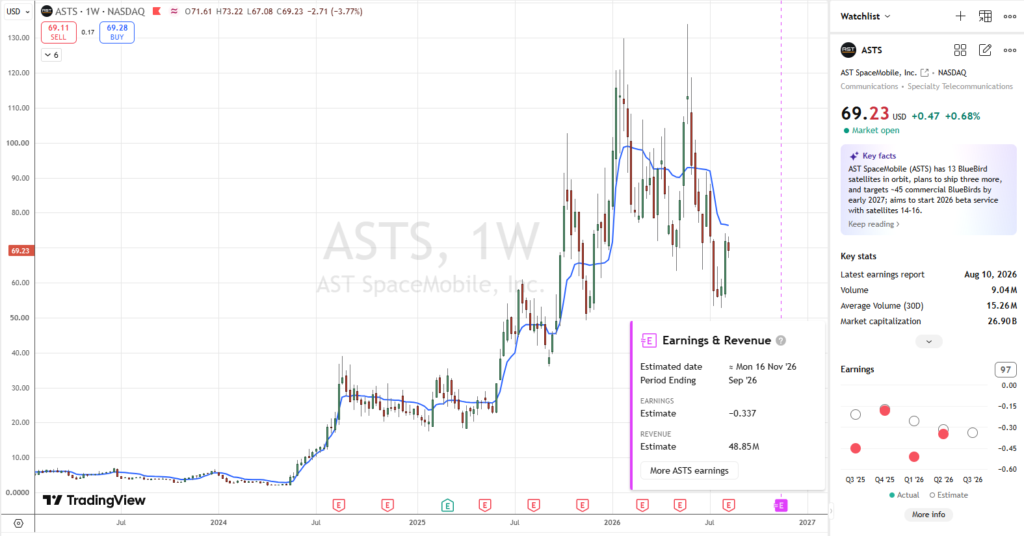
Upcoming Catalysts
Positive / supportive
- Additional BlueBird launches and successful deployments (target cadence every 1–2 months; path to ~45 satellites by early 2027 for continuous coverage in key markets).
- Initiation of beta services with strategic partners later in 2026 (possible with ~25 satellites for partial/daytime U.S. coverage).
- Conversion of backlog into sequential revenue growth; potential early commercial service revenue.
- Further U.S. government contract awards or expansion into programs of record; progress on Japan J-LEO or other international funded networks.
- Demonstrations of higher data rates, multi-user capacity, or new applications (radar, AI edge, emergency spectrum).
- Positive updates on spectrum access, gateway deployments, or MNO commercial launches/rollouts.
Negative / risk factors
- Launch delays, failures, or orbital issues (e.g., prior BB7 de-orbit).
- Further revenue or guidance misses; slower-than-expected backlog conversion.
- Competitive announcements (Starlink expansion, new entrants) or spectrum/regulatory setbacks.
- Additional dilutive financing if cash burn accelerates or timelines extend.
- Technical shortfalls in real-world network performance, interference, or handset compatibility at scale.
- Macro/market risk given the stock’s high volatility and growth-stock valuation.
Conclusion
AST SpaceMobile is executing one of the most ambitious infrastructure builds in public markets: a true broadband cellular network in space that works with the phones people already own. Success would unlock a large, recurring revenue stream from carriers serving billions of subscribers plus high-value government applications. The company has moved past pure concept risk into the execution phase, with satellites in orbit, a large backlog, strong partnerships, and a fortified balance sheetA financial "snapshot" that reveals exactly what a company owns and owes at a specific moment in time. It follows the fundamental formula: Assets = Liabilities + Equity. By subtracting what is owed (liabilities) from what is owned (assets), the balance sheet shows the "book value" or the net worth belonging to the owners. More.
The stock remains high-risk/high-reward. Near-term price action will be driven by launch cadence, beta service progress, and evidence that the 2027 revenue inflection is on track. Investors comfortable with execution and dilution risk see asymmetric upside if the network scales as planned; more conservative investors may wait for clearer commercial revenue and de-risked constellation milestones.