What Led to the Drop in the Fed’s Balance Sheet (April 2022 → March 2026)?
The Federal Reserve’s total assets—commonly referred to as its “balance sheet”—fell from about $8.9 trillion in April 2022 to roughly $6.6 trillion by March 2026. The primary driver was a policy called Quantitative Tightening (QT).
-
- Policy Implementation
Beginning in June 2022, the Fed started reducing its balance sheetA financial "snapshot" that reveals exactly what a company owns and owes at a specific moment in time. It follows the fundamental formula: Assets = Liabilities + Equity. By subtracting what is owed (liabilities) from what is owned (assets), the balance sheet shows the "book value" or the net worth belonging to the owners. More to “normalize” monetary policy after the pandemic and to address elevated inflation. - The “Roll-Off” Mechanism
Rather than actively selling assets, the Fed used a mostly passive approach. It allowed a set amount of Treasury securities and mortgage-backed securities (MBS) to mature each month without reinvesting the proceeds. - Monthly Caps
Initially, the runoff was capped at $47.5 billion per month. This was later increased to $95 billion per month ($60B Treasuries, $35B MBS) to accelerate the process. - Phases of Reduction
-
- 2022–2024: Rapid balance sheetA financial "snapshot" that reveals exactly what a company owns and owes at a specific moment in time. It follows the fundamental formula: Assets = Liabilities + Equity. By subtracting what is owed (liabilities) from what is owned (assets), the balance sheet shows the "book value" or the net worth belonging to the owners. More contraction from the $8.9 trillion peak
- 2025: The Fed slowed the pace (“tapered QT”) to avoid stressing financial system liquidity, and formally ended the reduction phase in December 2025
- March 2026: The balance sheetA financial "snapshot" that reveals exactly what a company owns and owes at a specific moment in time. It follows the fundamental formula: Assets = Liabilities + Equity. By subtracting what is owed (liabilities) from what is owned (assets), the balance sheet shows the "book value" or the net worth belonging to the owners. More stabilized near $6.6 trillion as the Fed shifted to maintaining a steady level of reserves
-
- Policy Implementation
How Did This Affect Bank Reserves?
The decline in total assets directly influences bank reserves, though not in a simple one-for-one way.
-
- Direct Liquidity Drain
When a bond matures and is not replaced, the money originally created to buy it is effectively removed from the system. Since bank reserves are the primary form of this money, QT puts downward pressure on reserves.-
- By March 2026, reserves have fallen from their 2022 highs
- Estimates suggest a “comfortable” level of reserves is about 10–12% of GDP (roughly $3.1–$3.8 trillion today)
- At around $3 trillion, reserves are approaching levels where banks become more cautious with liquidity
-
- The Role of a Key Buffer (ON RRP)
For much of the process, reserves did not fall as quickly as expected due to a buffer: the Overnight Reverse Repo (ON RRP) facility.-
- Money first drained from ON RRP (where money market funds park cash)
- This allowed reserves to remain relatively stable despite a $2T+ drop in assets
- By late 2025, ON RRP usage fell from over $2 trillion to near zero
- Only after this buffer was depleted did reserves begin declining more sharply
-
- Direct Liquidity Drain
Impact on Short-Term Interest Rates
As reserves declined more meaningfully in 2025–2026:
-
- Upward Pressure on Rates: Banks competed more actively for funding, pushing short-term rates (like SOFR) toward the upper end of the Fed’s target range
- Volatility Risk: The Fed halted QT in December 2025 partly to avoid a repeat of the September 2019 repo spike, when reserves became too scarce and overnight rates surged
Impact on Bank Behavior and Lending
Reserves are not just idle cash—they carry strategic value.
-
- The Fed pays interest on reserves (IORBThis is a policy rate set by the Fed. It is the "risk-free" return banks get for leaving cash at the central bank and acts as the floor for market rates. More), giving banks a safe alternative to lending
- As reserves decline, banks weigh this risk-free return more carefully
- The result: more selective lending behavior, which can tighten credit conditions for businesses and consumers
This tightening is often an early signal of slower economic activity.
How Can the Fed “Delete” Money?
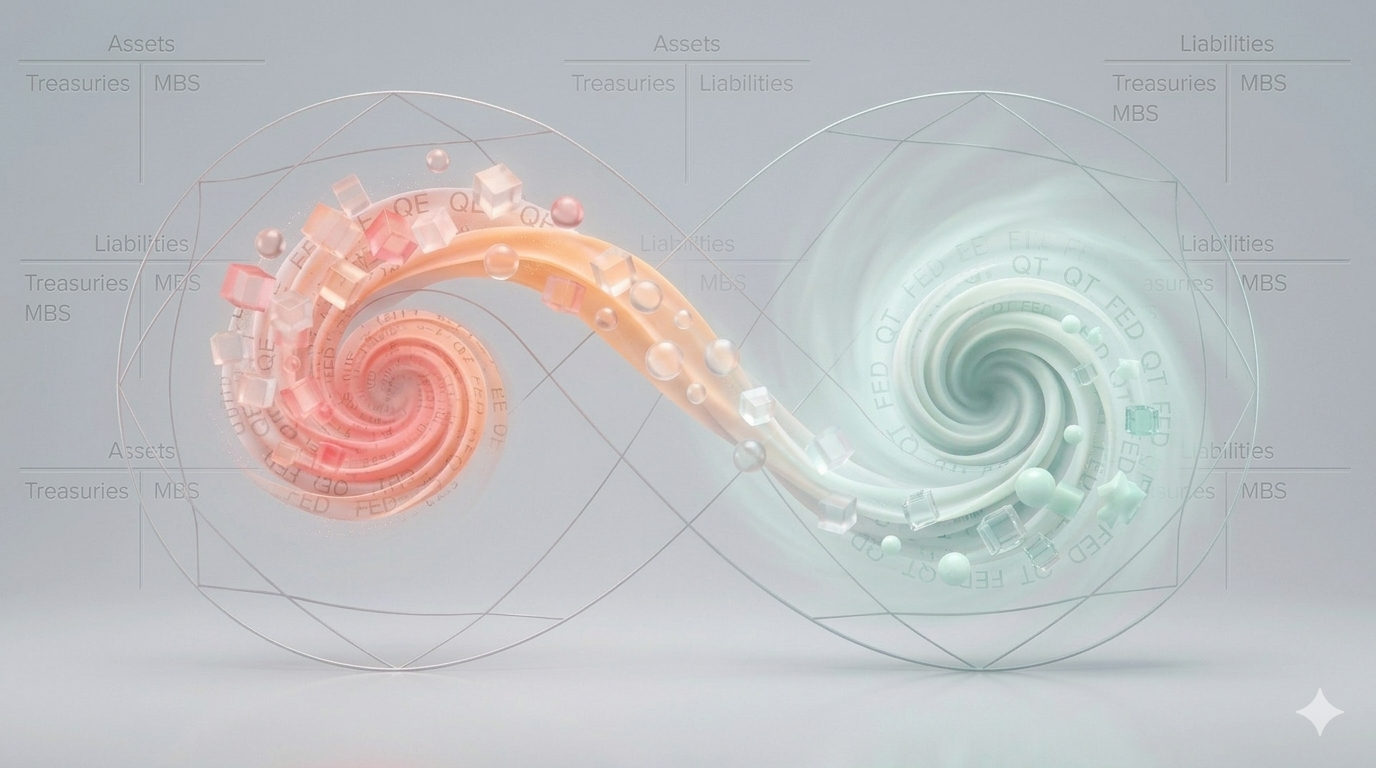
This is central to understanding QT. The process reverses how money was created during Quantitative Easing (QE).
-
- During QE (Creation)
The Fed buys bonds from the public (e.g., banks) and credits their accounts with newly created reserves. No existing money is used—balances are simply increased digitally. - During QT (Deletion)
When those bonds mature:-
- The Treasury repays the principal to the Fed
- The payment is deducted from the Treasury’s account at the Fed
- The Fed then removes the corresponding liability from its own balance sheetA financial "snapshot" that reveals exactly what a company owns and owes at a specific moment in time. It follows the fundamental formula: Assets = Liabilities + Equity. By subtracting what is owed (liabilities) from what is owned (assets), the balance sheet shows the "book value" or the net worth belonging to the owners. More
-
- During QE (Creation)
The Result:
Both the asset (the bond) and the liability (the reserves created to buy it) disappear. The money effectively ceases to exist.
Why Reduce the Balance Sheet?
By 2026, the Fed had several reasons to shrink its balance sheetA financial "snapshot" that reveals exactly what a company owns and owes at a specific moment in time. It follows the fundamental formula: Assets = Liabilities + Equity. By subtracting what is owed (liabilities) from what is owned (assets), the balance sheet shows the "book value" or the net worth belonging to the owners. More after the pandemic-era expansion:
-
- Controlling Inflation
QE adds liquidity and lowers rates, encouraging spending. QT does the opposite—removing liquidity and applying upward pressure on rates to cool demand. - Rebuilding Policy Capacity
A smaller balance sheetA financial "snapshot" that reveals exactly what a company owns and owes at a specific moment in time. It follows the fundamental formula: Assets = Liabilities + Equity. By subtracting what is owed (liabilities) from what is owned (assets), the balance sheet shows the "book value" or the net worth belonging to the owners. More gives the Fed room to expand again in a future crisis. - Restoring Market Function
A $9 trillion balance sheetA financial "snapshot" that reveals exactly what a company owns and owes at a specific moment in time. It follows the fundamental formula: Assets = Liabilities + Equity. By subtracting what is owed (liabilities) from what is owned (assets), the balance sheet shows the "book value" or the net worth belonging to the owners. More made the Fed a dominant player in bond markets. Reducing its footprint allows private investors to set prices more naturally. - Limiting Financial Risk
Holding large amounts of low-yield bonds while paying higher interest on reserves can lead to losses. A smaller balance sheetA financial "snapshot" that reveals exactly what a company owns and owes at a specific moment in time. It follows the fundamental formula: Assets = Liabilities + Equity. By subtracting what is owed (liabilities) from what is owned (assets), the balance sheet shows the "book value" or the net worth belonging to the owners. More reduces this risk and political scrutiny.
- Controlling Inflation
By March 2026, the Fed had largely achieved this “normalization”—removing excess liquidity while avoiding a severe funding squeeze.
How the Fed Buys Bonds (QE Mechanics)?
There’s often confusion here—the Fed does not buy directly from the Treasury.
- Treasury Issues Debt
The U.S. Treasury sells bonds to fund government spending deficits. - The Public (investors) buys the Debt
A diverse mix of domestic (eg. US mutual funds) and foreign investors (eg. foreign governments) buy these as they are considered low-risk and highly liquid. - Fed Buys in the Secondary Market
The Fed purchases those bonds from investors (via primary dealers), not directly from the Treasury. - The Swap
-
-
-
-
- Fed receives the bond
- Seller receives newly created reserves
-
-
-
Result:
The Fed holds government debt; the financial system gains liquidity.
Why It Feels Circular
Any profits the Fed earns are returned to the Treasury, making it seem like the government is paying interest to itself.
What Happens During QT?
The process reverses:
-
- The Fed lets bonds mature
- The Treasury repays the principal
- The Fed deletes the money
Importantly, the Treasury must repay the Fed—not the public—because the Fed is the bondholder at maturity.
The Broader Economic Effect
The system experiences what can be thought of as a “liquidity vacuum.”
-
- The Treasury issues new bonds to raise cash
- Private investors buy those bonds using existing money
- The Treasury uses that cash to repay the Fed
- The Fed deletes the money
Net Effect:
Money moves from the private sector → Treasury → Fed → disappears.
By March 2026, this process had removed roughly $2.3 trillion from the financial system.
Why Does the Treasury Send Borrowed Money to the Fed?
Because it must refinance maturing debt.
Step-by-Step Flow:
-
- Treasury issues new debt
It raises funds from private investors due to ongoing deficits - Treasury repays the Fed
The proceeds are used to pay off maturing bonds held by the Fed - Fed deletes the funds
The repayment reduces both assets and liabilities on the Fed’s balance sheetA financial "snapshot" that reveals exactly what a company owns and owes at a specific moment in time. It follows the fundamental formula: Assets = Liabilities + Equity. By subtracting what is owed (liabilities) from what is owned (assets), the balance sheet shows the "book value" or the net worth belonging to the owners. More
- Treasury issues new debt
Why This Matters
If the Fed recycled that money back into the economy, liquidity would remain unchanged. Instead, by removing it, the Fed makes money scarcer—helping to restrain inflation.
Bottom Line
The Treasury effectively acts as a pass-through:
-
- It pulls money from the private sector
- Transfers it to the Fed
- Where it is extinguished
That “vacuum effect” is the essence of Quantitative Tightening—and the reason the Fed’s balance sheetA financial "snapshot" that reveals exactly what a company owns and owes at a specific moment in time. It follows the fundamental formula: Assets = Liabilities + Equity. By subtracting what is owed (liabilities) from what is owned (assets), the balance sheet shows the "book value" or the net worth belonging to the owners. More shrank so significantly between 2022 and 2026.