
Voyager Technologies Inc. (NYSE: VOYG) is a defense and space technology company that provides mission-critical solutions for national security, civil, and commercial space sectors.
What does VOYG do?
The company’s operations are divided into three primary segments:
- Defense & National Security: Develops defense systems including missile defense interceptors, hypersonic missiles, and signals intelligence software. It also provides radiation-hardened communications and AI-powered edge computing products.
- Space Solutions: Delivers space infrastructure and technology, such as in-space propulsion systems, the Bishop Airlock on the International Space Station (ISS), and mission management services for academic and government missions.
- Starlab Space Stations: Operates through a joint venture to develop and run Starlab, a planned commercial space station intended to succeed the ISS and maintain a permanent human presence in low-Earth orbit.
What Value does VOYG offer?
The company offers value as a high-growth defense and space infrastructure provider with a focus on mission-critical national security and commercial space segments. Its value proposition relies on two key pillars:
- Strong Revenue Growth & Visibility
- Record Backlog: ended 2025 with a record $266 million backlog, providing significant revenue visibility for 2026.
- Raised Guidance: recently increased its 2026 revenue guidance to $225M–$255M, representing projected year-over-year growth of 35% to 53%.
- Defense Momentum: Defense and National Security segment grew 59% Y/Y in 2025, driven by key programs like the Next Generation Interceptor (NGI).
- Strategic Infrastructure & Innovation
- Starlab Commercial Upside: majority owner (approx. 61%) of Starlab, a planned commercial space station with payload capacity already fully reserved.
- Vertical Integration: Strategic acquisitions, such as Estes Energetics, have secured onshore manufacturing for critical chemicals and solid rocket motor inputs.
- High R&D Investment: plans to invest to strengthen its competitive moats in AI-enabled edge computing and throttle-“able” propulsion.
What is the Markets’ Take and Why?
Investors have adopted a “wait-and-see” approach. While institutional and long-term investors are optimistic about its role in the future of space infrastructure, short-term traders remain cautious due to ongoing losses.
Bullish – Massive growth potential
- Optimistic Financial Guidance: Management recently raised its 2026 revenue guidance and plans on becoming EBITDA positive by the end of 2027 and free cash flow positive in 2028.
- Robust Liquidity: As of year-end 2025, Voyager maintains over $700 million in total liquidity ($491M in cash and $213M in credit facilities) to fund growth and further acquisitions.
- Defense Momentum: The Defense and National Security segment saw a 63% increase in Q4 2025 net sales, driven by mission-critical programs like the Next Generation Interceptor (NGI).
- Starlab Commercial Interest: Voyager has fully reserved the commercial payload capacity for its Starlab space station, signaling strong future demand from commercial and government entities.
Bearish – Execution Risks and Losses
- Persistent Unprofitability: Voyager reported a net loss of $116.1 million for 2025 and missed Q4 revenue estimates, fueling concerns that profitability remains years away.
- Integration and Funding Risks: Heavy reliance on government contracts and the need for significant capital to fund Starlab development through 2030 pose major execution risks.
- Segment Decline: While defense is growing, the Space Solutions segment saw a 29% decline in Q4 2025 following the conclusion of a major NASA services contract.
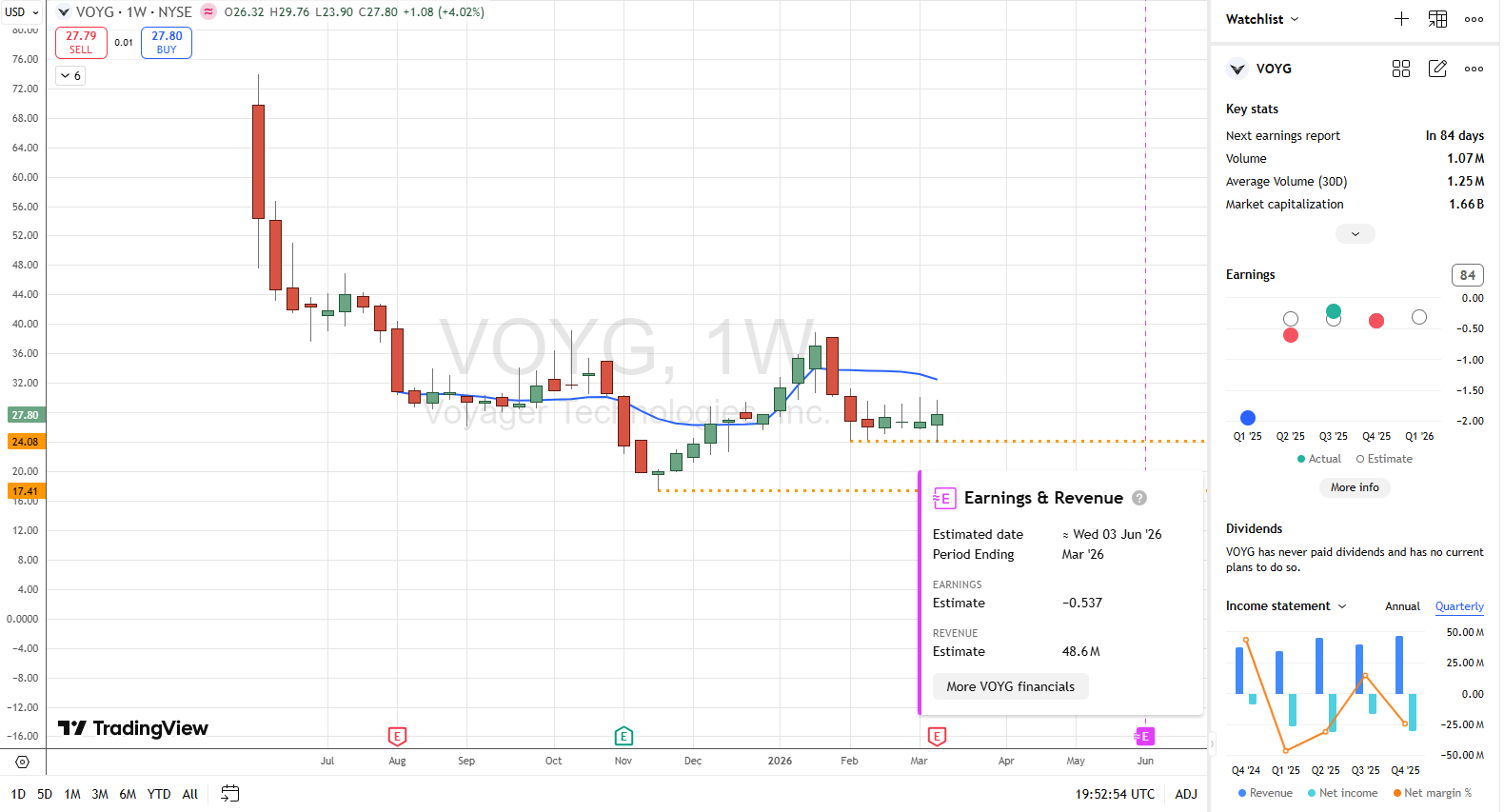
Upcoming Catalyst(s)
Primary near-term catalysts center on the company’s ability to execute its ambitious 2026 growth targets and hit critical development milestones for its commercial space station.
- NASA Commercial LEO Decisions
- CLD Phase 2 Selection: A pivotal NASA decision on the second phase of the Commercial LEO Development (CLD) program is expected in late summer or early fall 2026.
- Starlab Funding: Continued progress and funding awards for Starlab serve as major validation. Starlab recently completed its Commercial Critical Design Review, moving from design into full-scale fabrication and assembly in early 2026.
- Defense and Infrastructure Milestones
- Defense Complex Completion: Voyager is breaking ground on the 150,000-square-foot Voyager American Defense Complex in Pueblo, Colorado. Progress on this facility is a key indicator of its ability to scale high-volume production of missile defense components.
- Golden Dome Awards: Investors are watching for potential new awards under the “Golden Dome” missile defense architecture, where Voyager provides critical propulsion and guidance systems.
- Max Space Integration: Following its recent strategic investment, updates on expandable habitat modules for NASA’s Artemis program could provide immediate sentiment boosts.
- Financial Execution and Outlook
- 2026 Revenue Guidance: Quarterly earnings reports will be scrutinized to see if Voyager can convert its $266M backlog as it seeks to meet its revenue guidance.
- Path to Profitability: While currently unprofitable, any narrowing of net losses (which totaled $116M in 2025) or improvements in Adjusted EBITDA will be critical for institutional buy-in.
- Upcoming Investor Events
Management is scheduled to participate in several key industrials conferences where new contract updates or strategic shifts are often disclosed:- BofA Global Industrials Conference: March 17–18, 2026
- JP Morgan Industrials Conference: March 18, 2026
- 38th Annual Roth Conference: March 24, 2026
(** NOT FINANCIAL ADVICE **)
A successor to International Space Station (ISS) should be tempting enough to sell cash-secured PUTs with strikes between $20 to $25 and 30- 60 DTE.