
Planet Labs PBC (NYSE: PL) is an Earth-imaging and data analytics company that operates the world’s largest fleet of Earth-observation satellites. The company is a Public Benefit Corporation (PBC), meaning it is legally required to balance shareholder interests with its mission to “accelerate humanity toward a more sustainable, secure, and prosperous world“.
What does PL do?
Planet Labs primary mission is to image the entire Earth’s landmass every day, making global changes visible and actionable for businesses and governments. The company’s operations are divided into two primary segments:
-
- Satellite Constellations: PL designs, builds, and operates over 200 active satellites.
- PlanetScope (Doves): Hundreds of miniature “CubeSats” that provide near-daily, 3-meter resolution imagery of the whole Earth.
- SkySat: A high-resolution fleet capable of sub-50cm imagery and multiple “revisits” per day for specific locations.
- Pelican & Tanager: Next-generation fleets for even higher resolution and hyperspectral imaging to detect invisible gases like methane.
- Data Platform: The company processes 30 TB of data daily into a searchable “living atlas” through its Planet Insights Platform.
- Satellite Constellations: PL designs, builds, and operates over 200 active satellites.
What Value does PL offer?
PL’s value proposition revolves around providing daily, global Earth observation data to make global change visible, accessible, and actionable. Unlike traditional providers that focus on high-resolution “point-and-click” imagery of specific targets, PL images the entire Earth’s landmass every single day. Core drivers are:
-
- High-Frequency Global Scanning: PL provides a continuous “always-on” monitoring system through its 200+ active satellites, which allows customers to detect changes in near-real time that other providers might miss.
- “Time-Series” Data Archive: PL has built a unique decade-long historical database of daily images for every location on Earth. This “time-axis” enables users to go back in time to establish baselines, analyze trends, or investigate past events.
- Agile Aerospace & Cost Efficiency: Using low-cost “CubeSats” (Doves) and rapid iteration cycles, PL provides high-quality data at a significantly lower cost than traditional, large-scale satellite deployments.
- Actionable Analytics: Beyond raw imagery, PL offers automated AI-driven insights through its Planet Insights Platform.
- Agriculture: Monitoring crop health, predicting yields, and optimizing water/fertilizer use.
- Defense & Intelligence: Tracking military movements, monitoring borders, and responding to security threats in near real-time.
- Environmental Monitoring: Detecting illegal deforestation, measuring carbon storage, and tracking climate change impacts.
- Civil Government & Disaster Response: Assisting in urban planning, disaster damage assessment, and mapping.
What is the Market’s Take and Why?
Investor optimism about Planet Labs is tempered by the widening gap between market price and fundamental valuation.
Bullish
-
- Defense and Geopolitical Tailwinds: Global conflicts have seen demand surging for Planet’s “always-on” satellite intelligence. Revenue in the Defense & Intelligence segment recently accelerated by 72% year-over-year.
- Shift to “Satellite-as-a-Service”: Sovereign nations (like Japan and Sweden) pay upfront to “rent” dedicated satellite capacity. This “capital-light” approach reduces PL’s own spending while building a massive $734M+ backlog.
- Operational Milestones: The company has reached four consecutive quarters of positive adjusted EBITDA.
Bearish
-
- Extreme Valuation: Several models suggest the stock is significantly overvalued.
- Profitability Lag: While adjusted EBITDA is positive, the company remains unprofitable on a GAAP basis, reporting a net loss of $59.2 million in its most recent quarter.
- High Capital Intensity: Satellites remain expensive to build and launch which could continue to delay true bottom-line profitability.
Upcoming Catalyst(s)
-
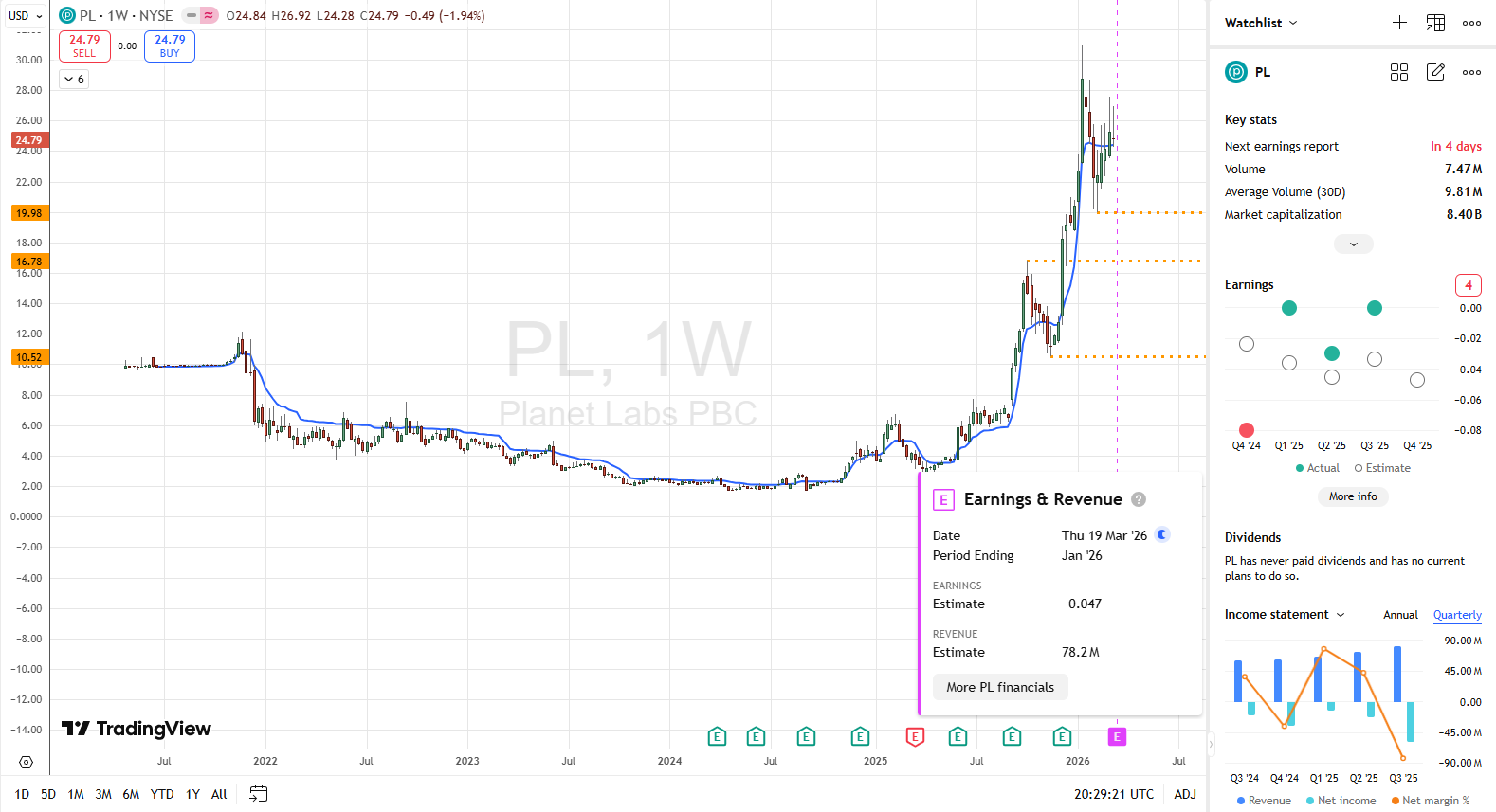
- Q4 & Full Year 2026 Earnings (March 19, 2026): scheduled to report its fiscal fourth quarter and full-year 2026 results after market close. Analysts are watching for revenue guidance near $78.17M and a narrower Adjusted EBITDA loss of ($5M) to ($7M).
- Contract Backlog Growth: Remaining Performance Obligations (RPO) recently grew to $672M.
- Satellite Constellation Expansion
- Pelican Fleet Deployment (H1 2026)
- Gen 2 Pelican Transition: shift to 30 cm-class resolution (down from 50 cm) is anticipated later in 2026, allowing Planet Labs to compete directly with legacy high-res providers.
- Tanager Hyperspectral Scale-up
- Geopolitical & Sector Catalysts
- U.S. Defense Budget (H2 2026): A potential jump in the FY27 U.S. defense budget (targeted near $1.5T) could catalyze new large-scale defense and intelligence contracts.
- European Production Ramp-up: New manufacturing facility in Berlin is intended to double production capacity to meet “exponentially growing” demand from European and NATO customers.
- SpaceX IPO Speculation hype
(** NOT FINANCIAL ADVICE **)
The practical implication of what Planet Labs offers might be incentive enough to sell cash-secured puts with strikes between $16 and $20 and 30 – 60 DTE.